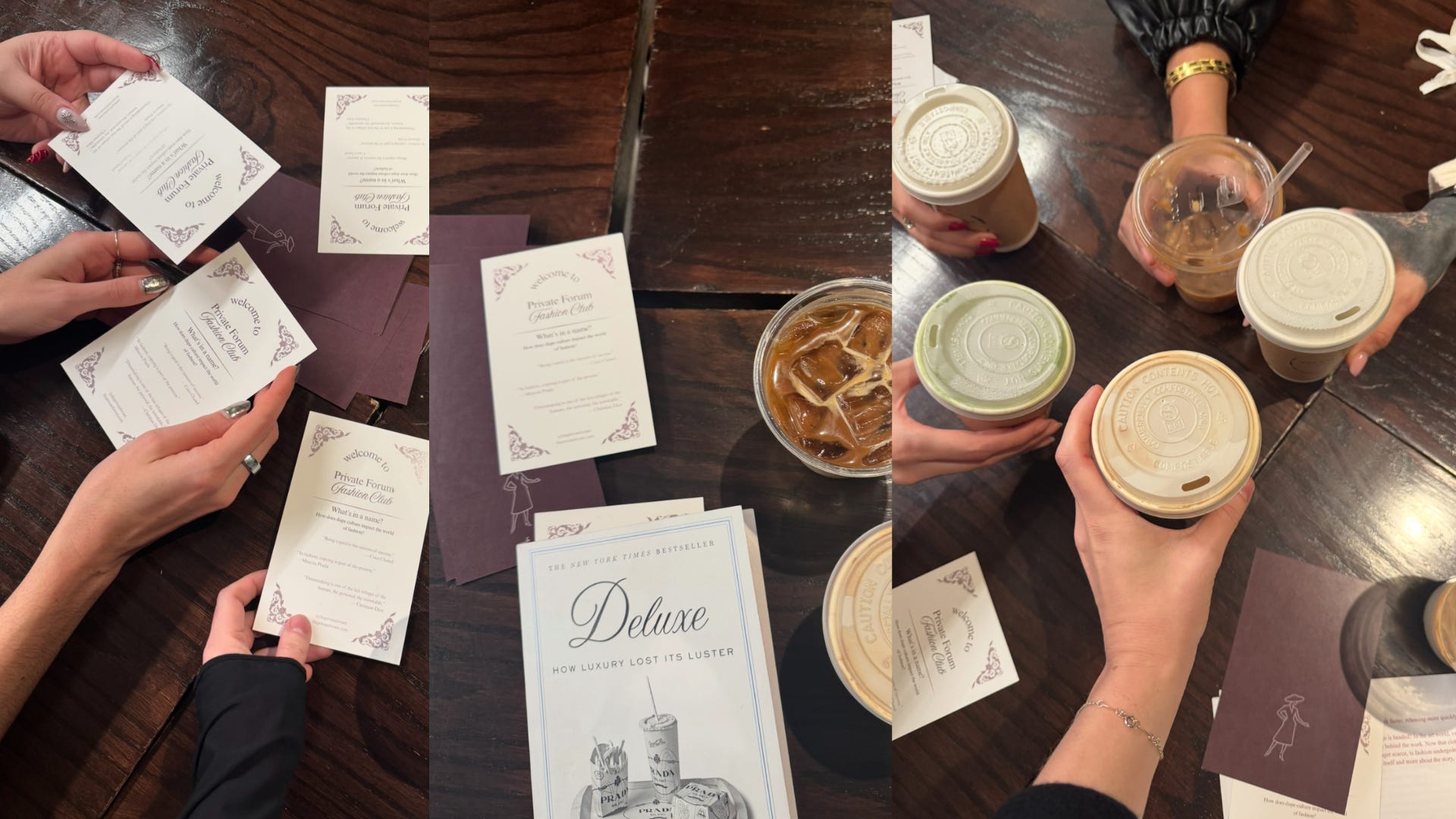
Twenty years ago, Zara copied high fashion. Today, everyone copies everyone. Dupes are no longer a subculture; they’re the norm. Each season feels like a race to monetize the same trending styles as quickly as possible.
Dupe culture undeniably accelerates a race to the bottom in quality, price, and environmental waste. But dupes aren’t the cause of fashion’s collapse.
They’re a symptom.
So how did fashion become so vulnerable to mass produced copies?
We all know that over the past two decades, manufacturing capabilities have improved dramatically. It’s easier than ever to find factories, and they’ve been optimized for variability: smaller minimums, more styles, more SKUs. Today, almost anyone can produce clothing. The main barrier is no longer production, it’s attention.
At the same time, discovery tools exploded. Shopify made it frictionless to open a store. Instagram shifted from a social app to a shopping app. TikTok became the ultimate haul machine. Affiliate marketing turned consumption itself into a business model, incentivizing influencers to buy, wear, and promote more clothing in a constant competition for engagement.
When everything can be made, the only real differentiator left is visibility. And we’ve never had more options and less clarity.
Mob wife. Demure. Cottagecore. Bubble skirts. Oxblood fall (thanks Sabato de Sarno). Leopard print winter. Each micro-trend competes to stop us from scrolling. Brands chase whatever will spike engagement.
In the race for attention, the definition of what’s “interesting” shifted. Trend cycles replaced standards. Somewhere along the way, we lost sight of the bar.
Not long ago, the decision on what was good or bad sat with curators: department store buyers, boutiques, local stylists. They filtered, edited, and took risks.
As shopping moved online, we traded those human filters for algorithms. We chose Google and Instagram over Barneys and independent boutiques, closing many of them down in the process. But algorithms didn’t replace curation with something more thoughtful. Alphabet and Meta simply took our attention and sold it to the highest bidder anyway.
Meanwhile, malls stopped buying as interesting of selections. They stopped curating their inventory. They stopped being entertaining or fun. Many gave up entirely, went bankrupt, and blamed e-commerce.
We didn’t replace human judgment with something better. We replaced it with ads.
In this environment, quality became nearly impossible to judge.
Cashmere can be long-fiber or short-fiber, and most shoppers wouldn’t know the difference. Silk can be pure, blended, chemically finished, and still look identical on the rack. Material labels imply quality, but there’s always an asterisk. Brands rarely disclose mills, finishing techniques, or actual manufacturing processes. They trademark new material names, obscure blends, and do things like market polyester as “satin” to imply silk.
Even pricing makes no sense. You can find a polyester skirt for $60, $200, or $1,000. That either means there are wild arbitrage opportunities in polyester, or that there are secret quality standards no one is meant to understand.
No wonder Gen Z rejected traditional luxury in favor of secondhand vintage and fast fashion. In a market with no shared quality standard, paying more stops making sense.
In a world where quality is illegible and curation has collapsed, dupes become logical.
In some ways, copying has always existed in fashion. Chanel famously called it the “ransom of success.” Dior licensed his designs to expand his influence. What’s changed isn’t copying itself, but its scale and speed. Image recognition technology, price extensions, and viral distribution now allow identical garments to be found and sold instantly at the lowest possible price.
What fashion needs now isn’t another shopping app, another comparison tool, or more product. It needs integrity.
So what should designers do now?
Should they resist dupes, embrace them, or rethink the value of fashion altogether?
And if everyone is making the same thing, how do we decide what’s actually worth wearing?